
Climate Experts · Tankless & hot-water heaters
Hot water for the way
your household lives.
Morning showers, laundry, dishes and a bath at the end of the day can ask a lot of your water heater. Climate Experts helps you choose a replacement around how your home actually uses hot water. From Navien tankless systems to conventional tanks and boiler-fed indirect tanks, we explain the options, review the installation and help you plan for dependable everyday comfort.
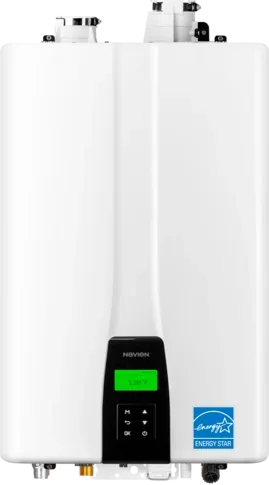
Start with your home’s needs, then choose the equipment.
Perhaps the tank is getting older, hot water runs out when showers overlap, or you wait too long at a distant bathroom tap. Those are different problems, and they do not all call for the same solution. We ask how many fixtures operate together, when demand is highest and what you would like to improve before recommending equipment.
Our team is based in Pickering and has served local homeowners since 2012. We bring broad heating and hydronic experience to the discussion, so your water heater is considered alongside the piping, available connections and other equipment in your home—not as an isolated box to replace.
Tankless, hot-water tank or indirect tank?
All three provide domestic hot water for taps, showers and appliances. The difference is how heat is supplied and how demand is handled. An indirect tank still stores hot water; “indirect” describes its connection to a separate heat source.
| System | How it provides hot water | What matters when choosing it |
|---|---|---|
| Tankless water heater | Heats water as it flows through the appliance; no large domestic hot-water storage tank. | Simultaneous hot-water flow, winter inlet temperature, supply connections and delivery time at taps. |
| Conventional hot-water tank | Stores heated water and reheats it using its own burner or electric elements. | Stored volume, recovery rate and first-hour output for your busiest period. |
| Indirect hot-water tank | Stores domestic hot water heated through a heat exchanger by a separate boiler; boiler water and domestic water stay separate. | Tank volume, boiler capacity, heat-exchanger rating, controls and domestic hot-water priority. |
Tankless can provide an extended supply at a flow the selected unit can support. It does not mean unlimited simultaneous showers. A storage tank can deliver a short burst of demand from its stored water, but needs time to recover. An indirect tank can be a useful option where a suitable boiler is already part of the home, with performance determined by the complete boiler-and-tank arrangement.
Navien tankless water heaters, selected for your household.
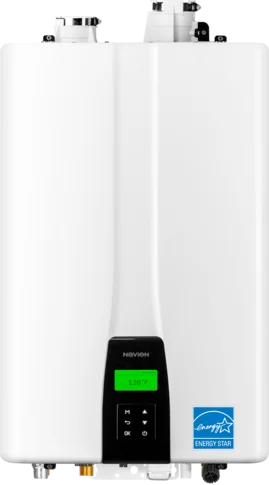
Navien is the tankless line we normally offer. Its NPE-A2 and NPE-S2 condensing models give us options for different hot-water demands and recirculation arrangements. We select the model around the flow you need and the installation, rather than assuming every home needs the largest unit.
A compact wall-mounted tankless heater can free up space occupied by a conventional tank. Converting to tankless still requires a review of gas supply, venting, condensate management, electrical supply, water connections and service access. Your existing tank’s connections are not automatically suitable for the replacement.
Cold incoming water matters in our climate. A tankless heater must raise that water to the required outlet temperature, and its available hot-water flow falls as that temperature rise increases. We use the selected model’s performance information when reviewing overlapping showers, large bath fills and other peak demand.
A sizing guide built around use—not just household size.
For tankless, we compare simultaneous hot-water demand with the manufacturer’s flow rating at the required temperature rise. For tanks, we compare the busiest hour with the selected model’s first-hour output and look at any large single draw. A household count helps us ask questions, but it cannot capture every showerhead, bath or daily schedule.
| Illustrative simultaneous use | Example mixed-water flow | What we review |
|---|---|---|
| One shower | 8 L/min | Your actual showerhead flow and whether another fixture overlaps. |
| Two showers | 16 L/min | How much heater-temperature water is needed after mixing with cold water. |
| Two showers + kitchen tap | 20 L/min | A higher simultaneous load; actual tap flow and temperature can change it. |
| Bath fill or multiple body sprays | Measure the actual fixture | High-flow fixtures can drive selection more than the number of people or bathrooms. |
These mixed-water flows are examples, not promises about your fixtures. Water at a shower is normally blended from hot and cold supplies; the water heater supplies only the hot portion. Appliances or fixtures operating at different temperatures must be considered separately.
Explore your hot-water demand
Enter one combined group of fixtures that runs together. Use the same blended-use temperature for that group. For a busiest-hour tank comparison, count every use in that hour. Example values are editable; they are not measured fixture ratings or instructions to change your water-heater setting.
Preliminary planning only. Results assume steady temperatures and ideal mixing, exclude distribution/recirculation losses and do not establish code compliance, an exact tank volume or a final model. Climate Experts confirms the actual fixtures, coldest inlet conditions, manufacturer ratings, controls and installation.
Navien A2 hot-water output by temperature rise.
Temperature rise is heater outlet temperature minus incoming cold-water temperature. For example, an assumed 50°C outlet and 6°C inlet require a 44°C rise. These are calculation examples, not recommended household settings.
| Required temperature rise | NPE-180A2 | NPE-210A2 | NPE-240A2 |
|---|---|---|---|
| 25°C | 24.6 L/min | 29.5 L/min | 32.9 L/min |
| 38.9°C | 15.9 L/min | 18.9 L/min | 21.2 L/min |
| 44.4°C | 14.0 L/min | 16.7 L/min | 18.5 L/min |
| 50°C | 12.5 L/min | 14.8 L/min | 16.7 L/min |
Manufacturer-rated flow at the water heater, in litres per minute. This table compares A2 models only; S2 ratings must be checked separately. The planner uses the next higher published rise point, without extrapolating outside the displayed performance data. Source: NPE-180A2, NPE-210A2, NPE-240A2.
Conventional hot-water tanks: storage plus recovery.
A replacement tank can be a practical choice when you want stored hot water and an installation that suits your home. We review the existing fuel or electrical arrangement, space, venting where applicable, condition and the pattern of demand. Two tanks with the same volume can have different recovery and first-hour performance.
What conventional tank size should your home start with?
For an ordinary household, the chart below gives a practical starting point for the conversation. Gas and electric tanks are shown separately because their recovery characteristics can differ. These are planning sizes, not a guarantee that a tank will meet every family’s needs; we confirm the selected model’s output and your busiest period before recommending it.
| Household / demand | Gas storage tank: starting point | Electric storage tank: starting point |
|---|---|---|
| 1–2 people; ordinary daily use | 30–40 US gal · 114–151 L | 30–40 US gal · 114–151 L |
| 2–3 people; ordinary daily use | 40 US gal · 151 L | 40 US gal · 151 L |
| 3–4 people; ordinary daily use | 40–50 US gal · 151–189 L | 50 US gal · 189 L |
| 5+ people; ordinary daily use | 50 US gal or larger · 189 L+ | 80 US gal or larger · 303 L+ |
| Large bath, high-flow showers or clustered use | Assess a larger or faster-recovery option using actual demand | Assess a larger or faster-recovery option using actual demand |
For example, four people taking short showers at different times may need a different arrangement from four people using a large bath and two showers together. If your current tank runs out, tell us when that happens: a larger tank, faster recovery or a different system may be worth comparing. We do not size a water heater by floor area or bathroom count alone.
The household starting points are adapted into this Climate Experts guide from manufacturer household-size guidance. Actual fuel type, element or burner output and use patterns are reviewed separately. Tank sizes above use US gallons, not Imperial gallons. First-hour rating describes how much hot water the selected heater can deliver over the first hour starting with a heated tank; it includes recovery. It is not the same as tank volume. The planner estimates a preliminary peak-hour hot-water requirement, not a tank size. A large one-time bath fill may still need a separate storage check.
Indirect hot-water tanks: domestic hot water from your boiler.
An indirect tank uses a heat exchanger connected to a separate boiler. Heat transfers into the stored domestic water without mixing it with the boiler circuit. This can suit an existing hydronic home when the boiler, tank and controls are matched to the hot-water requirement.
What indirect tank size should we consider?
An indirect tank cannot be assigned a reliable size from the number of occupants alone. The same tank can deliver very different first-hour and recovery performance with different boilers or operating conditions. The storage sizes below are options to discuss against your home’s demand—not an indirect version of the household chart above.
| Indirect storage size to discuss | Home’s demand pattern to assess | What must support that size |
|---|---|---|
| Around 30 US gal · 114 L | Modest peak draws; a smaller storage option to review. | Enough boiler and coil output to recover between uses; confirm a large single draw separately. |
| Around 55 US gal · 208 L | Family demand with more clustered showers or a bath to account for. | Published recovery at the actual boiler conditions and adequate usable storage for the largest draw. |
| Around 80 US gal · 303 L | Higher peak volume, larger baths or repeated draws in a short period. | Sufficient boiler output, coil performance and controls to replenish the additional stored water. |
| Around 119 US gal · 450 L | Very high domestic demand where a larger storage arrangement is being considered. | A complete project-specific review; the tank volume alone does not establish capacity. |
A smaller indirect tank with a properly matched boiler may recover quickly enough for a household that would otherwise consider more storage. A large bath may still require a larger volume ready at once. Conversely, fitting a large tank to a limited heat source can leave you with a long recovery period. We compare both the biggest single draw and the busy-hour demand.
The indirect sizes shown are illustrative storage categories available in manufacturer ranges, not a commitment to a specific brand or model. Model numbers do not always equal actual stored gallons; we confirm the selected tank’s real volume and performance data.
We review the boiler’s available output, the tank coil rating, recovery and the effect of domestic hot-water priority on space heating. A larger tank does not make up for every heat-source limitation. The complete arrangement determines how it performs during busy periods and when the heating system is also needed.
Recirculation: less waiting at distant hot-water taps.
After a tap is turned off, hot water in the pipe gradually cools. At the next use, that cooled water has to move out before newly heated water reaches the fixture. A recirculation arrangement moves water through a planned return path to help keep the hot-water line ready when you need it. It reduces delivery delay; it does not increase the heater’s maximum hot-water output.
NPE-A versus NPE-S: what changes?
Homeowners often call them NPE-A and NPE-S. The current models compared here are the NPE-A2 and NPE-S2; older A/S installations need their own model-specific review. Both are tankless heaters. The key distinction for this conversation is the A2’s integrated ComfortFlow pump and buffer tank.
| Question | Navien NPE-A2 — Advanced | Navien NPE-S2 — Standard |
|---|---|---|
| Built-in recirculation equipment | ComfortFlow includes an internal pump and small buffer tank. | No built-in recirculation pump or ComfortFlow buffer tank. |
| Dedicated household return line | The built-in pump can serve a suitable external return arrangement, subject to design limits. | Requires a suitable external pump and controls for a recirculation arrangement. |
| No dedicated return line | A compatible NaviCirc arrangement can use the cold-water line as the return. | A compatible NaviCirc arrangement also needs an external pump and the required controls/components. |
| What determines the choice? | Useful to consider when recirculation is a priority; piping and control setup still matter. | Useful to consider when integral recirculation is not needed, or where a designed external arrangement is appropriate. |
Dedicated return piping
Water returns to the heater through a separate line. The route, loop length, pump capability and control method are reviewed as a complete arrangement.
NaviCirc where suitable
A compatible crossover valve can use the cold supply as the return path when a dedicated line is unavailable. That can make cold water temporarily warm at affected fixtures; we discuss the trade-off and compatibility.
Controls that fit your routines
Suitable schedules, demand activation or other manufacturer-supported control options can reduce unnecessary circulation. Controls and accessories vary; they are confirmed in the proposal.
Internal circulation within an A2 is different from circulating through your home’s plumbing. An internal-only configuration does not preheat the line to a distant bathroom. To shorten that wait, the installation needs an appropriate external return or compatible crossover arrangement, correctly configured.
The small A2 buffer tank helps smooth intermittent hot-water operation; it is not a conventional storage tank. Recirculation also uses energy to replace pipe heat losses. We review pipe insulation, controls and the selected manufacturer’s operating and warranty requirements rather than promising free, instant hot water everywhere.
Replacement & installation with the whole job explained.
Understand your household
Review peak use, existing equipment, distant fixtures and what you want the replacement to improve.
Confirm the installation
Check sizing, supply connections, venting where required, condensate, access and any recirculation work.
Approve equipment & price
The proposal identifies the selected equipment and included work. Fixed pricing applies from start to finish, with no hidden fees or additional costs for the approved quoted scope.
Learn the system
Review operation, controls and the care appropriate to the installation, with a local team to contact afterward.
If a tank is rented, review your existing agreement and return or buyout arrangements before proceeding. Rental contract obligations are separate from the equipment installation proposal.
Financing is subject to credit approval. Review the offered terms and total borrowing costs before accepting an agreement.
Water-heater repairs, service & maintenance.
If you have no hot water, changing temperatures, reduced performance or an error display, tell us the make, model and what you have noticed. We assess the cause before recommending a repair. We explain the findings and proposed work so you can make an informed decision about repairing or replacing older equipment.
Tankless care depends on water quality and the manufacturer’s instructions. We review appropriate flushing or descaling, inlet screening and installation checks rather than giving every home the same unverified interval. Storage and indirect tanks have different care needs, including relevant components, connections and controls.
Tankless water heaters and hot-water tanks can be discussed as Maintenance 365 add-ons. Each home’s enrolled equipment, coverage and price are confirmed separately; they are not automatically included in the matched furnace/air-handler and heat-pump/A/C base plan.
See typical water heater prices.
Brand: Navien tankless.
Questions homeowners ask about hot water.
Will tankless give us unlimited hot water?
It can provide an extended supply at a flow the installed unit can support. Simultaneous fixtures and incoming water temperature still limit output; sizing must reflect your peak use.
Why does winter water temperature affect sizing?
Colder incoming water needs a greater temperature rise. At that higher rise, a tankless unit has less available hot-water flow than its warmer-inlet rating.
Does the calculator tell me exactly which unit to buy?
No. It provides an ideal-mixing demand estimate and A2 capacity comparisons at published temperature-rise points. We confirm real conditions, service requirements and the full installation before selecting equipment.
Is a 50-gallon tank enough for four people?
The household count is only a starting point. Shower flow, bath volume, overlapping use and the selected heater’s recovery and first-hour output determine the suitable choice.
How is an indirect tank different from a regular tank?
It receives heat from a separate boiler through a heat exchanger instead of relying on its own burner or heating elements. The boiler and tank are assessed together.
Does an NPE-A2 automatically make distant taps hot immediately?
No. Internal circulation and household recirculation are different. The home needs a suitable external return or compatible crossover arrangement and control setup to reduce that wait.
Can the NPE-S2 have recirculation?
Yes, in an appropriate arrangement using an external pump, controls and required components. It does not include the A2’s built-in ComfortFlow pump and buffer tank.
Do you serve my area?
Climate Experts serves Pickering, Ajax, Whitby, Oshawa, Scarborough, Toronto, Markham, Richmond Hill and Stouffville from our Pickering location. We work with residential and light commercial customers and do not work on condos.
Your local hot-water replacement & service team.
You should not have to plan your day around an ageing water heater. Tell us what is happening at home and what a better hot-water experience would look like. We will help you compare the practical options, understand the scope and move forward with a clear proposal.
Climate Experts Heating & Cooling Inc. has been part of the Pickering community since 2012. From Unit 13, 905 Dillingham Rd, our local team brings pride in its workmanship and the helpful service reflected in our five-star customer feedback.
HOME COMFORT ANSWERS · CLIMATE EXPERTS
Hot-water questions that come up in everyday homes.
The number of people in the house is only part of hot-water planning. The fixtures running together, winter inlet temperature, tank recovery and the distance to the tap can all affect the experience. We help you separate capacity questions from delivery-time questions.
Why do I still wait for hot water with a tankless heater?
The water sitting in the pipe between the heater and the fixture still has to travel before hot water arrives. A tankless heater therefore does not automatically make a distant tap instant. A suitable recirculation arrangement can reduce the wait, but the return path, controls and insulation matter. We explain the proposed piping and operating schedule so you know what to expect from the selected Navien arrangement.
Discuss this with Climate ExpertsCan two showers run together with a tankless water heater?
Possibly, but the combined fixture flow and required temperature rise must fit the selected model’s output. Colder winter inlet water can reduce the available hot-water flow compared with a warm-water brochure example. Tell us about simultaneous showers, tubs and other fixtures. Our hot-water sizing tool helps organize those needs; we verify the equipment, gas supply and installation before promising a particular combination.
Discuss this with Climate ExpertsDoes a tankless water heater need flushing or descaling?
Follow the maintenance requirements for the exact unit and your water conditions. Scale, inlet screening, combustion components and the condensate arrangement may need attention, depending on the installation. A flush is not the complete maintenance scope for every tankless heater. Climate Experts reviews the model and service history, explains what the visit includes and can quote ongoing coverage for the equipment.
Discuss this with Climate ExpertsWhy does my storage tank run out of hot water?
A high-demand shower, tub fill or several fixtures running together can use stored hot water faster than the tank recovers. A changed thermostat, failed component or other fault can also reduce performance. Tell us whether the problem is new and which fixtures are being used. We compare usable storage and recovery with your household’s demand before recommending a larger tank, tankless unit or indirect arrangement.
Discuss this with Climate Experts